
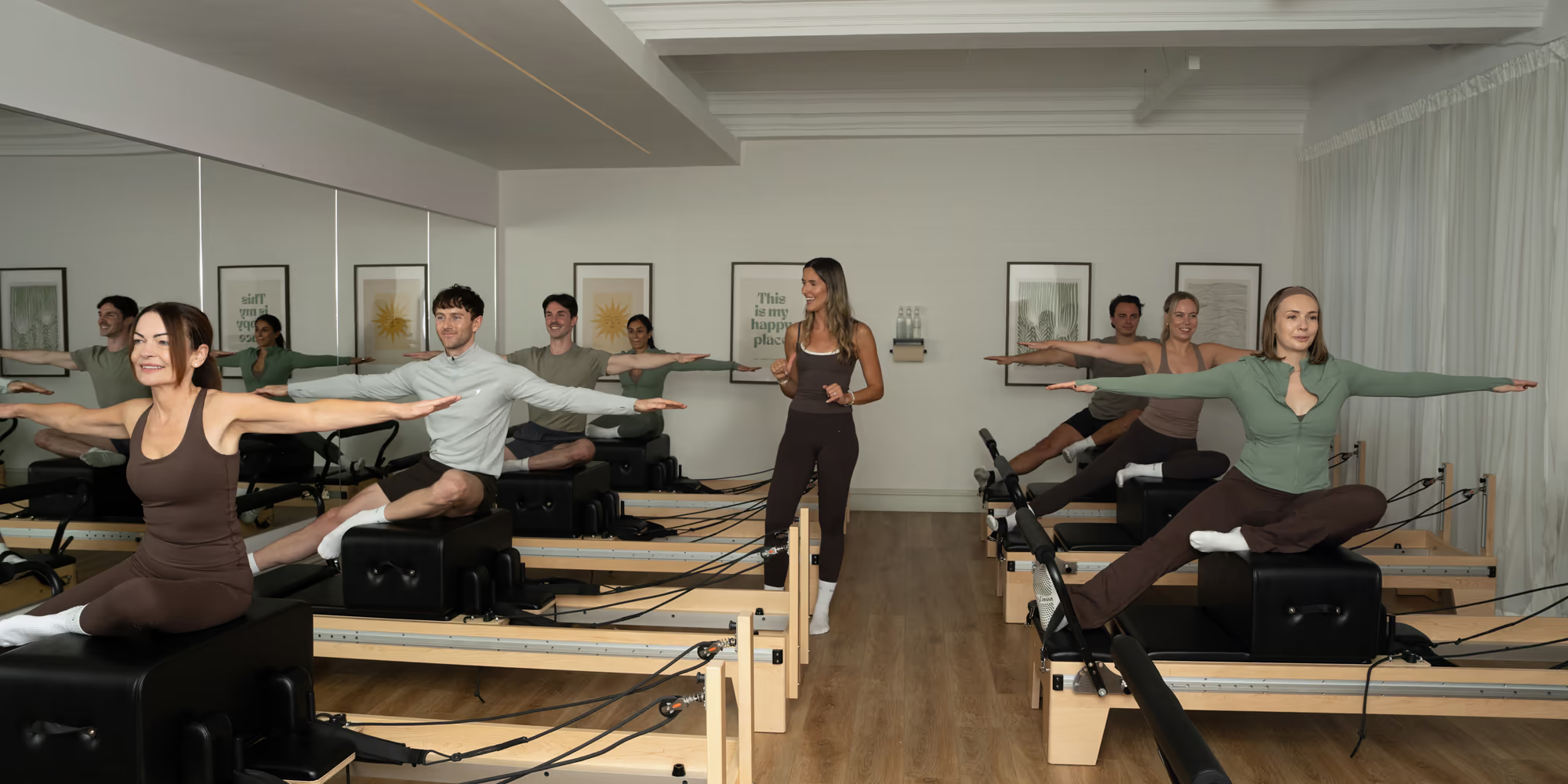
If you know the feeling of walking downstairs the morning after a long run, this one’s for you. Running is brilliant, and it asks your body to do the same thing over and over. Our Stretch & Recovery class at our Lewisham studio gives it something different.
What running asks of your body
Every run repeats one pattern thousands of times. Your legs swing forward and back through a fairly small range, and your hips, hamstrings and calves do the work again and again.
Your spine has four main movements: bending forward, bending back, bending to the side and rotating. A run uses small amounts of them, stride after stride, and rarely takes your spine through its full range.
What mobility does for your running
Staying relaxed can help you run more efficiently. Your ankles, hips, spine, ribs and shoulders all move with every stride, and your arms swing to balance your legs. Stretch & Recovery gives those joints time to move through their full range, so you can start your next run feeling looser.
Plenty of runners spend hours with hockey balls and foam rollers. We’d put more of that time into mobility, because that’s where we think the biggest improvement comes from.
How we work on it in class
After thousands of quick strides, Stretch & Recovery is a chance to slow down. It’s a deep stretching class, and the reformer is the tool: the springs and carriage support you into each position, and you stay there for longer, with light resistance and nothing forced. Your teacher cues your breath as you go and offers easier and deeper options for every position.
For runners, that means time on your ankles, hips and the backs of your legs, and taking your spine, ribs and shoulders through their full range.
How often should you come?
If you’re new to this and after more mobility, we’d start with two classes a week and build from there. Try them on the easier days in your week, or when you’re easing back in after a heavy block of training. Every level is welcome from day one, and if you’ve never been on a reformer, your teacher will show you around it first.
If it’s more than tightness
If you’re working through an injury, or pain that isn’t going away, have a word with your GP or physio first, and tell your teacher at the start of class. They’ll cue you towards the options that suit you.
Come and try it
Our intro offer is three classes for £33 over fourteen days, and it works on every class on the timetable. Bring grip socks (we sell them at the studio if you forget). The door opens fifteen minutes before class, so there’s time to settle in.